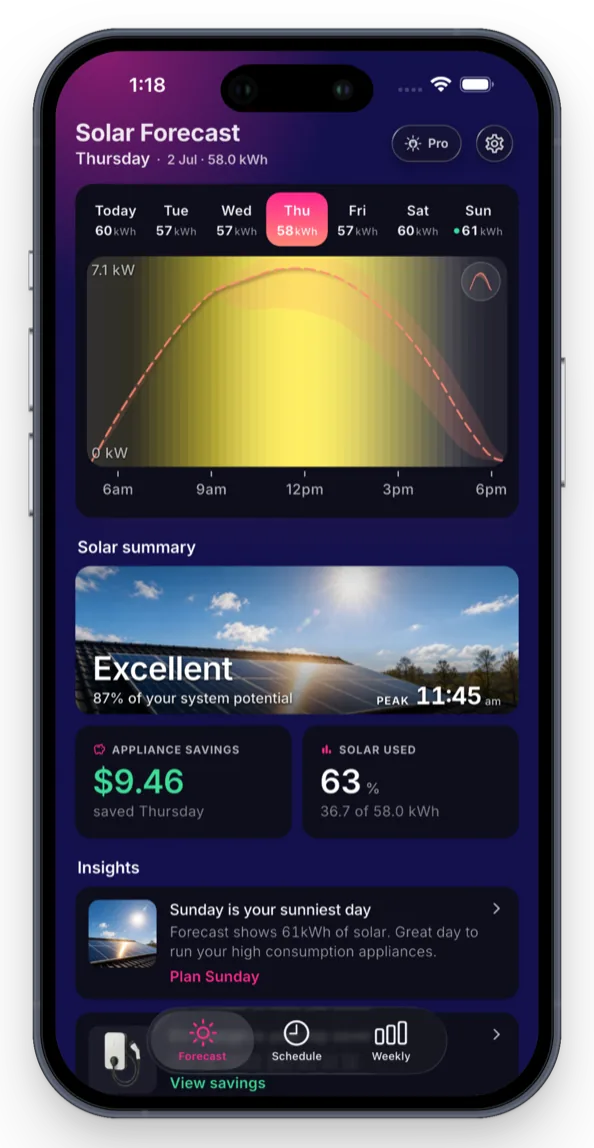
You spent thousands on solar panels expecting lower electricity bills. But the bills barely moved. Here's why it's happening to millions of households around the world, and what you can actually do about it.
The Uncomfortable Truth About Residential Solar
Solar panels are one of the best investments a homeowner can make. The technology works, the savings are real, and the environmental benefits are undeniable. But there's a catch that most solar installers don't emphasise: the savings depend almost entirely on when you use electricity, not just how much your panels produce.
The average solar household exports somewhere between 50% and 70% of the energy their panels generate. That exported energy earns a feed-in tariff, typically between 5 and 10 cents per kilowatt-hour. Later that same day, they buy electricity back from the grid at full retail price: 25 to 45+ cents per kWh depending on where you live.
That price gap is where your savings disappear. You're essentially selling your solar energy at a discount, then buying it back at a premium.
50-70%
of solar energy exported by the average home
5-8x
price gap between feed-in and retail rates
$600+
potential yearly savings from better timing
The Timing Mismatch Nobody Warned You About
Your solar panels produce the most energy between roughly 9am and 3pm. But think about what your household is doing during those hours. If you're at work and the kids are at school, nobody is running the washing machine, the dishwasher, or charging the car. The house might be drawing just 500 watts for the fridge and a few devices on standby, while your panels are generating 4,000 watts or more.
All that surplus energy flows straight back to the grid. Your meter spins backwards, sure, but you're credited at a fraction of what you'll pay when you start cooking dinner, running the dryer, and heating the house at 6pm.
Most households generate far more solar energy than they use during peak sun hours
Solar installers talk about system size, payback periods, and annual generation figures. But they rarely mention the single biggest factor that determines your actual bill savings: self-consumption. That's the percentage of solar energy you use directly in your home rather than sending it to the grid.
What Is Self-Consumption and Why Does It Matter?
Self-consumption is the metric that separates solar owners who save a fortune from those who wonder why their bills haven't changed. A household with 30% self-consumption uses less than a third of the solar energy it generates. The other 70% gets exported for a small feed-in credit. A household with 70% self-consumption uses most of what it generates, dramatically reducing the amount of expensive grid power it needs to buy.
The difference in real money? A 6.6kW system in a typical household might save $400 a year at 30% self-consumption. Push that to 70% and you could be saving $900 to $1,200 a year from the same panels, with no extra hardware. The panels haven't changed. The weather hasn't changed. The only thing that changed is when you used the electricity.
The Appliances That Make the Biggest Difference
Not all appliances are equal when it comes to solar shifting. The ones that matter most are "flexible loads": appliances that draw a lot of power but can run at any time of day without affecting your routine. For the hour-by-hour detail on each one, see the best time to run appliances with solar.
Washing Machine500W for 1-2 hours
Dishwasher1,200W for 1-2 hours
Clothes Dryer2,000-5,000W for 1-2 hours
EV Charger2,000-7,000W for 2-8 hours
Pool Pump750-1,500W for 4-8 hours
Air Conditioner1,000-3,500W for 2-6 hours
Running your dishwasher at 7pm instead of 11am can be the difference between free solar power and full-price grid power. Multiply that across your washing machine, dryer, pool pump, and EV charger over a whole year and the numbers add up fast.
Shifting flexible appliance loads to midday hours is the single most effective way to cut your electricity bill
Why "Just Use It During the Day" Isn't Enough
If you've read any solar advice, you've probably heard "run your appliances during the day." That's directionally correct but far too vague to be genuinely useful. Here's why:
Solar output changes every day. A cloudy Tuesday might produce half the energy of a clear Wednesday. If you run your dryer on the wrong day, you're still pulling from the grid.
The peak window shifts with the seasons. In summer your solar might peak from 10am to 3pm. In winter it could be 11am to 1pm, with half the output. Our blog post on solar output in summer vs winter shows how big that gap gets where you live.
Panel orientation matters. Equator-facing panels (north-facing in the Southern Hemisphere, south-facing in the Northern) peak around midday. East-facing panels peak earlier. West-facing panels peak later.
Stacking appliances backfires. Running everything at noon might exceed your solar output, pulling from the grid anyway. Spreading loads across the solar window is more effective.
What you actually need isn't a rule of thumb. You need a forecast that predicts your specific solar production each day, accounting for your panels, your location, and the weather.
How Solar Forecasting Changes Everything
Solar forecasting uses real weather data (cloud cover, temperature, humidity, atmospheric pressure) combined with your panel configuration (capacity, tilt, orientation) and geographic location to calculate how much energy your system will produce through each day. How solar forecasting works walks through the weather models and the physics behind that calculation.
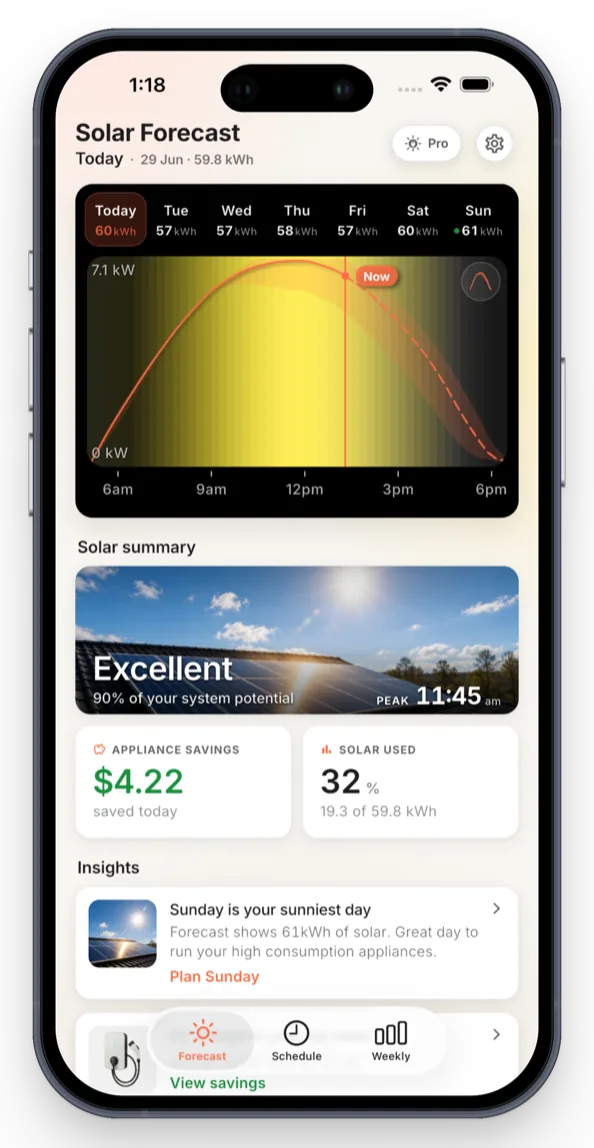
Instead of guessing whether today is a good day to run the dryer, a forecast tells you: "Your panels will produce 28 kWh today. Peak output of 4.2 kW will be between 10:30am and 1:00pm. Best time to start your washing machine: 11am."
OnSun is a free solar forecast app for iPhone and Android that predicts how much your rooftop panels will produce, and when, through each day of the week ahead, and shows the best time to run each appliance. There is no hardware to install. Enter your panel size, roof direction, tilt and location. It reminds you when it is time to press start and does not switch anything on or off.
That level of specificity is the difference between vague advice and actionable savings. For a static version of that curve, the free solar output calculator shows a typical summer day, winter day and cloudy day for your location and panel setup.
Solar forecasting turns your panels from a passive installation into an active savings tool
EV Charging: The Biggest Opportunity Most People Miss
If you own an electric vehicle or plug-in hybrid, solar-aligned charging is where the biggest savings hide. An EV charger draws 2 to 7 kW continuously, which can consume your entire solar output for hours. Charging during peak solar instead of overnight can save $500 to $1,500+ per year in electricity costs alone.
Many EV owners plug in when they get home at 6pm and charge overnight on expensive grid power. Simply shifting that charge to the middle of the day (when the car is at home on weekends, or using a timer on weekdays) can cut your charging costs by 70-80%.
Charging your EV during peak solar hours instead of overnight can save over $1,000 a year
What About Batteries?
Home batteries like the Tesla Powerwall solve the timing problem by storing solar energy for use in the evening. They work well, but they're expensive: typically $10,000 to $18,000 installed. The payback period can be 7 to 12 years.
Smart appliance scheduling achieves a similar outcome for free. You won't eliminate evening grid usage entirely, but shifting your biggest loads into the solar window captures the majority of the available savings without any capital investment. It's the first step every solar household should take, whether or not you plan to add a battery later. If you want the numbers for your own home, the battery vs load shifting calculator simulates ten years of both options on a year of your local weather, and our analysis of whether a solar battery is worth it in 2026 works through the east-coast Australian, US and UK cases.
How OnSun Helps You Do All of This
OnSun is a free solar forecast app for iPhone and Android that predicts how much your rooftop panels will produce, and when, through each day of the week ahead, and shows the best time to run each appliance. For each planned run it shows the share your solar will cover and the estimated saving.
There is no hardware to install. Enter your panel size, roof direction, tilt and location. Add your appliances and the plan is ready in about a minute. OnSun works with any grid-connected solar PV system, anywhere in the world. The 3-day forecast is free; OnSun Pro unlocks the full week.
Most solar households export 50 to 70% of the energy they generate for a low feed-in tariff, then buy electricity back at full retail price in the evening. The panels produce at midday and the house uses most of its power in the morning and evening. Shifting the washing machine, dishwasher, dryer and EV charger into the solar window is the cheapest way to close that gap.
Self-consumption is the share of your solar energy used in your home instead of exported to the grid. A typical household sits at 25 to 35%. Shifting flexible appliance loads into the solar window can lift that to 60 to 80%, which is the difference between saving a few dollars a week and several hundred dollars a year from the same panels.
The high-draw flexible loads: washing machines (500W), dishwashers (1,200W), clothes dryers (2,000 to 5,000W), EV chargers (2,000 to 7,000W), pool pumps (750 to 1,500W) and air conditioners (1,000 to 3,500W). They draw a lot of power and can usually run at any time of day without changing your routine.
Yes. OnSun is a free solar forecast app for iPhone and Android that predicts how much your rooftop panels will produce, and when, through each day of the week ahead, and shows the best time to run each appliance. It sends a reminder when it is time to press start and never switches anything on or off. The 3-day forecast is free; OnSun Pro unlocks the full week.
See Your Solar Forecast
OnSun forecasts your own roof for the week ahead and shows the best time to run each appliance. Nothing to install, and the 3-day forecast is free.
7-day solar production forecast
Best time to run each appliance
Solar coverage percentage per load
Weekly savings tracker
Works with any solar system worldwide
Start Using Your Solar Smarter
Download OnSun and see when to run each appliance on your own solar. The 3-day forecast is free; OnSun Pro unlocks the full week. No hardware needed.
For questions about the app itself, see the OnSun FAQ.