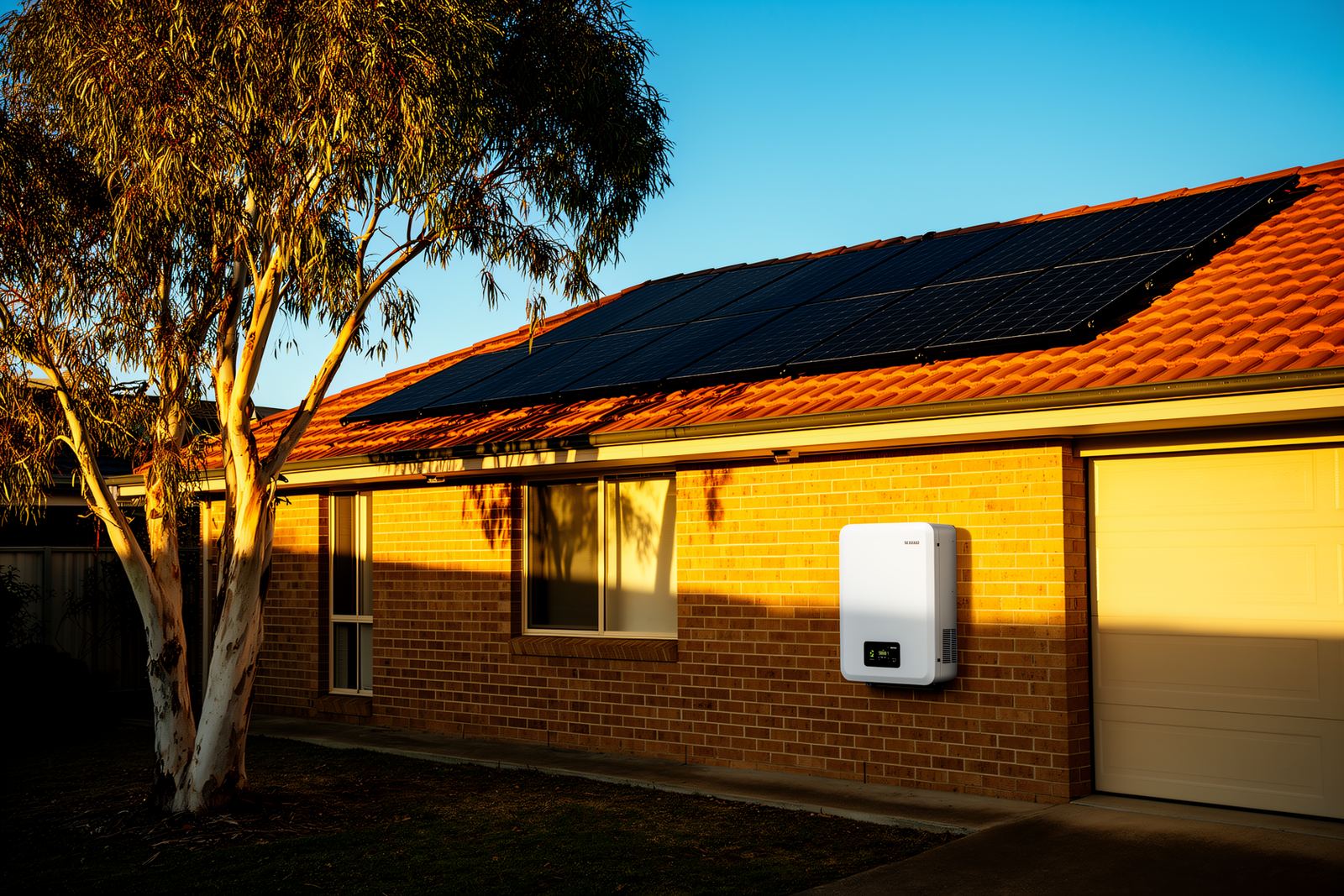
TL;DR: Is a home battery worth it? On the Australian east coast, yes, if you can wait. At the prices CHOICE publishes, a 10, 15 or 20 kWh battery all take nine to ten years to pay for itself in Sydney, Brisbane and Melbourne. Changing when you run your big appliances costs nothing and is worth $200 to $500 a year from the first week, depending on whether there is an electric car in the driveway. Over ten years the free habit leaves you further ahead than any of the batteries. Over fifteen, the battery wins, and the bigger it is the more it wins by. Do both and you beat either.
A home battery is worth it on the Australian east coast, provided you can wait nine to ten years to get your money back and you plan to be in the house longer than that. That is the short answer from a model of Sydney, Brisbane and Melbourne, run for three battery sizes at the prices CHOICE publishes, on a free calculator we built around the solar modelling in the OnSun app. The longer answer is that the battery is the second thing to do, not the first.
The decision you are actually making
You know the problem. Your surplus goes to the grid for around 5 cents a kilowatt-hour and you buy it back that evening at around 35. The installer's answer is a battery. Before you price one, ask yourself a simpler question. Can I use more of my power during the day?
If the answer is yes, that is the first thing to do, and this article puts a dollar figure on it next to the battery. If the answer is no, because nobody is home and there is nothing to move, the battery is the only lever you have and the numbers below still apply to it.
So the question is not "battery or no battery". It is how much each of these gets you, how long each takes, and whether they add up.
What we tested
The numbers come from the battery versus load shifting calculator on this site, which uses the same solar modelling as the OnSun app and simulates a whole year hour by hour. A typical family home in Sydney, Brisbane and Melbourne. Three or four people, someone home part of the weekday, electric hot water, reverse-cycle air conditioning, panels sized to make about what the house uses in a year.[3] Each home was run twice, once with an electric car charging overnight on a 7 kW wall charger and once with no car. The car matters a great deal, so keep an eye on which version I am talking about.
The weather is the part people underestimate. A kilowatt of panels in Brisbane makes about twice as much in December as a kilowatt in Melbourne makes in June. In winter there is less surplus to store and less to shift, so the savings from both options are smaller in the months when bills are highest.
What a kilowatt of panels makes each month in the three cities
Kilowatt-hours per kW of installed panels, by calendar month, for the typical year the model used. Unshaded north-facing roof pitched near the latitude. Over the year: Brisbane about 1,443 kWh per kW, Sydney 1,412, Melbourne 1,305.
Source: OnSun battery versus load shifting simulator, September 2026, on Open-Meteo ERA5 archive data, 2021 to 2026, composed into one typical year per city.[3]
How long until a battery pays for itself
Payback can be nine to ten years. A 10 kWh battery at $9,000 breaks even in about nine years and five months in Sydney and Brisbane, and nine years seven months in Melbourne. The 15 kWh battery at $13,000 lands in the same place. The 20 kWh at $16,500 takes a few months longer, just past ten years in Sydney and Melbourne. The reason is that price and saving rise together. The 10 kWh unit saves about $920 a year, the 15 kWh about $1,300 and the 20 kWh about $1,500, and each of those is roughly a tenth of what it cost.
Years for a battery to pay for itself, three sizes, three cities
Installed prices are the midpoints of the after-rebate ranges CHOICE publishes for each size.[4] Battery on its own, nothing timed, 35c import and 5c export, panels sized to the home's annual use. The dashed line is a typical ten-year warranty.
No electric car
Electric car on a 7 kW wall charger
Source: OnSun battery versus load shifting simulator, September 2026, on Open-Meteo ERA5 archive data.[3] Prices from CHOICE, last updated 26 August 2026, based on SolarQuotes data.[4]
Having a car changes almost nothing here either. The car charges at night, the battery is already empty by then, and the break-even moves by a month or two. Whether you drive an EV or not, the battery is a nine to ten year wait.
CHOICE's own payback table, for an $8,500 battery and a household using 7 kWh overnight, has Brisbane at 7.7 years, Sydney at 8.3 and Melbourne at 13.9.[4] Ours are a little longer in Sydney and Brisbane and a lot shorter in Melbourne, mostly because we ran all three cities at the same 35 cent tariff and CHOICE did not. Both tables say the same thing. A battery on the east coast is a wait of the best part of a decade.
What you have at the end of the wait depends on how long the battery lasts, and this is where size does matter. At year ten the 10 kWh battery has put you about $600 in front. At year fifteen, if it is still going, about $5,700. The 20 kWh battery is roughly at zero at year ten and about $9,000 in front at fifteen. Most home batteries carry a ten-year warranty, so buying one is a bet that it lasts well past that, and the bigger battery is the bigger bet.
| Battery | Saves per year | Breaks even | Ahead at 10 years | Ahead at 15 years |
|---|---|---|---|---|
| 10 kWh, $9,000 | $920 / $940 | 9.4 / 9.3 years | $602 / $741 | $5,685 / $5,873 |
| 15 kWh, $13,000 | $1,290 / $1,350 | 9.5 / 9.2 years | $655 / $1,180 | $8,050 / $8,766 |
| 20 kWh, $16,500 | $1,480 / $1,630 | 10.1 / 9.4 years | -$161 / $1,127 | $9,107 / $10,887 |
What shifting your loads does, without a battery
The model moves five loads into the sunniest hours: the dishwasher, the washing machine, the dryer, the car when it is home, and the air conditioner on hot afternoons so the house is cool before the sun drops. Nothing to buy, and the saving starts the first week.
Without a car, it is worth about $215 to $255 a year in the three cities. The appliances you can move are small, and the gain sits inside the 2 to 15 percentage points the research literature reports for this kind of change.[1] A dishwasher run is about a kilowatt-hour, a washing machine load half of one, and the model shifts only two to three kilowatt-hours a day. Left untouched, the house uses about a fifth of what its panels make, which is in line with what metered Australian homes show.[2] Timing gets that to a little under a third.
With a car, it is worth about $450 to $500 a year. A wall charger putting 40 km of range into the car uses around 7 kWh, more than the dishwasher, washing machine and dryer put together. Charging it at midday instead of midnight is the single largest free change a solar household can make.
Because it costs nothing, timing is ahead from the first week and stays ahead of the battery for a long time. After ten years the free habit has earned you $2,400 to $2,900 without a car and $5,100 to $5,700 with one. The 10 kWh battery, by year ten, has earned you about $600.
Sydney: where you stand, year by year, for fifteen years
Cumulative bill savings minus what you paid, in Australian dollars. A typical family home, panels sized to its annual use, 10 kWh battery at $9,000 installed, 35c import and 5c export. Timing costs nothing, so its line starts at zero and only climbs. The battery's line starts at minus its price. Brisbane and Melbourne land within a few hundred dollars of these curves.
No electric car
Electric car on a 7 kW wall charger
Source: OnSun battery versus load shifting simulator, September 2026, on Open-Meteo ERA5 archive data for Sydney, 2021 to 2026.[3] Panel output fades 0.5% a year. The battery is assumed to last fifteen years.
The gold line starts at minus $9,000, crosses zero a little after year nine, and ends year fifteen around $5,700 up. The coral line starts at zero and climbs more slowly, with nothing to pay back. Without a car the battery overtakes timing around year thirteen. With a car, timing is still well ahead at year fifteen.
Doing both
The green line is the battery and the habit together, and it is the best outcome in every run. In the Sydney car house, timing alone is $5,103 up at year ten, the 10 kWh battery alone $741 up, and both together $6,408. They add, because timing works on your daytime loads and the battery on your evening ones.
Building the simulator, the result that surprised us was how much the habit still matters once a battery is on the wall. We expected the battery to make daytime irrelevant. It does not. In the Sydney house with no car, a 10 kWh battery on its own still leaves about 2,700 kWh a year coming from the grid, and timing on top of it cuts that to about 2,000. That is around $240 a year, every year, for pressing start at a different time. With a car it is about $570 a year, because the car is the load the battery cannot cover.
The smaller the battery, the more this matters. With the 20 kWh battery in the same no-car house, timing on top is only worth about $40 a year, because the big battery already covers almost every evening. With the 10 kWh it is worth six times that. A 10 kWh battery is empty before a winter evening is over, and what you ran during the day decides how far it stretches.
So what should you do
Start with the free step, whatever you decide about the battery. It takes a week to get used to and it makes the battery better if you buy one.
| City | Battery alone breaks even | Battery plus timing breaks even | Battery alone at 10 years | Timing alone at 10 years |
|---|---|---|---|---|
| Sydney | 9.4 / 9.3 years | 7.6 / 6.1 years | $602 / $741 | $2,417 / $5,103 |
| Brisbane | 9.4 / 9.3 years | 7.3 / 6.0 years | $612 / $703 | $2,883 / $5,470 |
| Melbourne | 9.6 / 9.5 years | 7.7 / 6.0 years | $413 / $514 | $2,450 / $5,668 |
Without an electric car, the battery is worth it if you are staying ten years or more. A 10 kWh battery is about $600 ahead at year ten and $5,700 by year fifteen. A 20 kWh one sits at zero at year ten and $9,000 ahead at fifteen, so go bigger only if you trust the fifteen years. If you might move within five, you would still be $4,000 to $8,000 behind.
With a car, charge at midday first and decide about the battery afterwards. Daytime charging is worth about $500 a year on its own, which is more than any of the three batteries adds on top of it in the first decade. The battery is still a nine to ten year wait, and it still pays. Buy it if you are staying. Charge the car at lunchtime either way.
Everything above is at 35 cents in and 5 cents out. A higher export rate or a cheaper import rate stretches the battery's wait. A time-of-use tariff with an expensive evening peak shortens it. Perth, the US and the UK get different answers for that reason, and that is its own article. The feed-in tariff versus self-consumption post covers the export side.
Ask the installer one question: at my tariff, with my dishwasher, washing and car charging moved into the middle of the day, what year does this battery break even? If they cannot answer it, the payback figure on the quote was worked out for a house that is not yours.
Check your own house
Your tariff, your quote and the loads you can move are all different from the three homes above. The calculator below runs the same model on your own numbers. Nothing is stored, and the only thing that leaves the page is a map coordinate used to fetch the weather archive for your location.
OnSun's forecast of the best hours to run each appliance is the timing half of this in practice. It tells you when tomorrow's sun will be strongest for your roof and reminds you to press start. It never switches anything on or off. The solar guide covers the basics and support can help with setup.
Key takeaways
- On the Australian east coast a 10, 15 or 20 kWh battery at CHOICE's published prices takes nine to ten years to pay for itself. Size changes what you have at year fifteen, from about $5,700 to $9,000 ahead, not how long you wait.
- Running your big appliances in daylight costs nothing and is worth $215 to $255 a year without a car, $450 to $500 with one. Over ten years it leaves you further ahead than the battery does.
- Both together is best. The Sydney car household is $6,408 ahead at ten years with a 10 kWh battery and the habit, against $5,103 for timing alone and $741 for the battery alone.
- A battery does not make daytime irrelevant. Timing on top of a 10 kWh battery still saves $240 to $570 a year. With 20 kWh it saves far less, because the big battery covers the evening on its own.
Frequently asked questions
On the east coast, yes, if you can wait. At the after-rebate prices CHOICE publishes, a 10 kWh battery at $9,000 pays for itself in about nine and a half years in Sydney, Brisbane and Melbourne at 35 cents import and 5 cents export, then earns about $920 a year. A 15 kWh at $13,000 and a 20 kWh at $16,500 take about the same time. At year fifteen the 10 kWh battery has you about $5,700 ahead and the 20 kWh about $9,000. If you might move within five years you would still be four to eight thousand dollars behind.
Nine to ten years in the model, for 10, 15 or 20 kWh batteries at $9,000, $13,000 and $16,500 on a typical family home in Sydney, Brisbane or Melbourne. Price and yearly saving rise together, so size barely moves the break-even. Whether the house has an electric car changes it by only a month or two, because the car charges at night when the battery is already empty.
Yes. Running the dishwasher, washing machine and dryer in daylight, and charging an electric car at midday instead of overnight, is worth $215 to $255 a year without a car and $450 to $500 with one, at no cost. Over ten years that is $2,400 to $2,900 without a car and $5,100 to $5,700 with one, which is more than any of the three battery sizes has earned you by the same point.
No. OnSun forecasts your system's output from weather models and tells you the best hours to run each appliance. It does not switch anything on or off, needs no hardware, and does not model battery payback. The battery versus load shifting calculator on this site is a separate free tool that runs the simulation used in this article on your own location and prices. Every saving it shows is an estimate, not a guarantee.
References
- EuropeLuthander, R., Widen, J., Nilsson, D. & Palm, J. (2015). "Photovoltaic self-consumption in buildings: A review." Applied Energy, 142, pp. 80-94. doi:10.1016/j.apenergy.2014.12.028. Free full-text postprint: Linkoping University Electronic Press. The standard reference for what storage and demand-side management do to self-consumption; its pooled studies are European and predate home car charging. Back to text
- AustraliaGoldsworthy, M. (2025). "Solar PV self-consumption trends in Australia." Solar Energy Advances, 5, 100119. doi:10.1016/j.seja.2025.100119 (open access). Metered data from more than 27,000 Australian dwellings; supports the low untimed starting point used here, since measured self-consumption is falling as arrays grow. Back to text
- ModelModel runs, September 2026. Produced by running the simulator behind the battery versus load shifting calculator on this site for Sydney, Brisbane and Melbourne, once with an electric car on a 7 kW wall charger and once without, with 10, 15 and 20 kWh batteries priced at the midpoint of CHOICE's after-rebate ranges ($9,000, $13,000 and $16,500), against the Open-Meteo historical weather archive, which serves ERA5 reanalysis data under CC BY 4.0. Five years of hourly shortwave and diffuse radiation and temperature per city, 2021 to 2026, composed into one typical meteorological year. Roofs assumed unshaded, pitched near the latitude and facing north. Household demand is a modelled shape built from stated answers, not a metered load. Tariff 35c import, 5c export, flat. Panel output fades 0.5% a year and the battery is assumed to last fifteen years. Limitations: this is a reproducible model, not measured data, and it describes one typical year. Back to text
- AustraliaBarnes, C. "Solar battery guide: How to buy the best system for your needs." CHOICE, last updated 26 August 2026. choice.com.au. Source for the after-rebate installed price ranges used here (10 kWh $7,000 to $11,000, 15 kWh $11,000 to $15,000, 20 kWh $14,000 to $19,000, which CHOICE attributes to SolarQuotes data), and for its own payback table for an $8,500 battery. Back to text
Battery prices are midpoints of published ranges and the tariff is a flat east coast average, not quotes. Any unattributed range is an indicative market figure. Modelled savings are estimates, never guarantees.